
 By Admin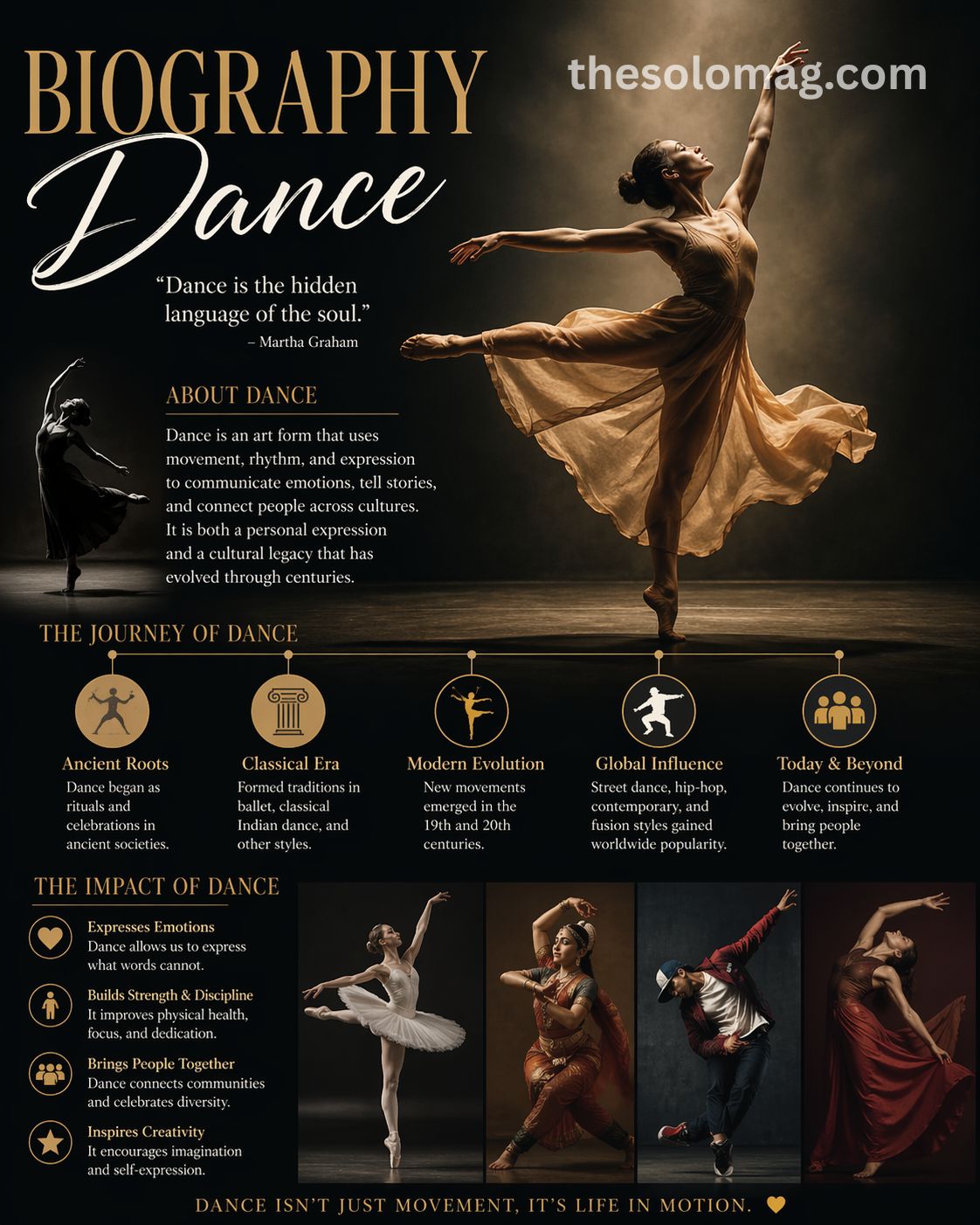
Have you ever watched a dancer on stage and felt like you just read their entire diary? That is the magic of a biography dance. It is more than just choreography. It is a raw, physical translation of a human life onto the stage.
In 2026, audiences crave authenticity. We don’t just want tricks; we want truth. It strips away the filters and shows the scars, the victories, and the quiet moments of a person’s journey.
Whether you are a freelancer documenting your struggles or a student writing a dance biography examples project, this art form connects deeply. Let’s explore how to write, perform, and understand the power of dancing a life story.
What Exactly is a Biography Dance?
It is a performance piece that narrates the specific events, emotions, and timeline of a real person’s life. Unlike abstract dance, this genre relies on narrative clarity.
Think of it as a memoir, but your body is the pen. For example, a small business owner might create a biography dance about the stress of opening their first coffee shop—the frantic arm movements representing morning rushes, the slow collapse representing burnout.
Biography vs. Autobiography in Dance
It is vital to distinguish the two:
-
Biography dance: Told by an external choreographer about another person (e.g., a piece about Frida Kahlo).
-
Autobiographical dance: The dancer tells their own story.
Most biography of a dancer pieces fall into the first category. You are stepping into someone else’s shoes. You need research, empathy, and a willingness to become a vessel for their history.
The Golden Rules of Writing a Dance Biography
When crafting it examples sheet for a program note, you need concise power. You have 50 words to make an audience care.
Here is how to write a professional dance biography:
-
Start with impact: “A two-time Bessie nominee…” not “She was born…”
-
Include the “Why”: Mention it they are performing tonight.
-
Human details: Don’t just list awards. Mention their dog, their injury, or their comeback.
Real-life example: “Maria rarely speaks of her limp. But when she performs her biography dance about her grandmother, a war refugee, that limp becomes a symphony of survival.”
Iconic Figures Who Mastered the Biography Dance
History is full of stars who turned life into rhythm. To understand the genre, study the masters.
Fred Astaire: The Biography Dancer Actor Films Icon
No discussion is complete without fred astaire biography dancer actor films. Astaire didn’t just dance; he documented the anxieties of the upper class through tap.
-
Experience: His relentless perfectionism (he rehearsed for months) shows in every frame.
-
Expertise: He merged ballet with jazz.
-
Lesson for you: In your it, find the unique rhythm of your subject’s speech or walk. Astaire turned his subject’s nervous energy into art.
Eddie Kamae – A Life of Hawaiian Soul
Look at eddie kamae born august 4 1927 biography grandmother dancer. Kamae preserved Hawaiian culture. His biography dance would not be complete without the hula his grandmother taught him. This proves that a biography dance is also a historical document.
Modern Voices – Will West and Don Campbell
-
Will west dancer biography: West uses acrobatics to depict his battle with ADHD. His movements are chaotic, then suddenly still—mimicking his medication schedule.
-
Don campbell dancer biography: The creator of “Campbellocking” turned street rivalry into a comedic biography dance of his youth in Los Angeles.
How to Structure Your Own Biography Dance (Step-by-Step)
Ready to build your piece? Follow this 2026-approved blueprint for a biography dance.
1: Research the Timeline
You need three moments: Before, During, After.
-
Before: The subject’s childhood (Soft, rounded movements).
-
During: The conflict (Sharp, angular, chaotic).
-
After: The resolution (Controlled, wide stances).
2: The “Did Dancer Prince Biography” Question
Many ask: Did dancer prince biography exist? Yes. Prince (the musician) used minimal movement to create massive presence. Ask yourself: Does my subject need power or vulnerability?
3: Choreograph the Turning Point
In every biography of a dancer, there is a “fall.” Maybe a literal fall, a job loss, or a betrayal.
-
Action: Slow that fall down to 30 seconds.
-
Result: The audience holds their breath.
4: Add the “Kupe Dance” Energy
Look at the a-star ghanaian artiste biography kupe dance challenge. That challenge went viral because it celebrated overcoming shame through hip movement. Inject local, viral energy into your biography dance to keep it relevant for 2026 audiences.
Real-Life Applications: Not Just for Pros
You don’t need a theater to use a biography dance.
-
For Therapists: Use movement history to help patients with PTSD unlock non-verbal memories.
-
For Teachers: Assign it instead of an essay to engage kinesthetic learners.
-
For Corporate Teams: A dance biography examples exercise breaks down hierarchy. The CEO dances their first job (sweeping floors), the intern dances their dream.
Related: [How to Use Movement for Stress Relief in Remote Work]
Common Mistakes When Creating a Dance Biography
Even pros mess up. Avoid these pitfalls to keep your biography dance authentic.
-
1: Only happy moments. The Fix: Show the messy divorce, the bankruptcy, the acne. Truth lives in the ugly.
-
2: Literal miming. The Fix: Don’t just pretend to drive a car. Dance the feeling of being stuck in traffic.
-
3: Forgetting the audience. The Fix: A biography dance is not a private diary. It is a gift. Make sure your pain translates to universal empathy.
SEO & Social Media Strategy for Your Dance Biography
In 2026, your piece needs eyes. Use these keywords naturally.
If you are uploading a video of your biography dance, use this caption strategy:
-
Title: “My Grandmother’s War | A Biography Dance”
-
Description: “This biography dance explores resilience. Like eddie kamae born august 4 1927 biography grandmother dancer, I honor my roots. #BiographyDance #MovementMemoir”
FAQs
Q:1 What is it in simple terms?
It is a dance that tells the true story of a specific person’s life, from birth to legacy or a key turning point.
Q:2 How long should a biography dance be?
For competitions, 3 to 5 minutes. For a full evening show, 15 to 20 minutes. Attention spans in 2026 favor shorter, punchier narratives.
Q:3 Can I do a biography dance about myself?
Yes, that is specifically called an autobiographical dance. However, a true it is usually about someone else.
Q:4 What are good dance biography examples for beginners?
Start with a pet. Dance the life of your dog. It is low stakes, teaches timing, and audiences love humor.
Q:5 Who is will west it?
Will West is a contemporary dancer known for integrating parkour into emotional storytelling, specifically regarding mental health.
Q:6 Tell me about a-star ghanaian artiste biography kupe dance challenge.
A-Star is a Ghanaian artist who started the “Kupe Challenge” to celebrate overcoming shyness. His biography dance involves a signature backward slide that represents “moving away from fear.”
Q:7 Did dancer prince biography exist?
Prince Rogers Nelson was a musician, but his dance biography exists in his stage shows. He used subtle isolations to convey massive ego and fragility.
Q:8 Who is Don Campbell dancer?
Don Campbell invented “Locking.” His story is one of survival—using comedy and dance to avoid gang violence in 1970s LA.
Q:9 How is Eddie Kamae (born August 4, 1927) relevant today?
Kamae proved that dance can save a culture. He recorded his grandmother’s hula to preserve Hawaiian traditions and prevent them from fading away.
Q:10 Do I need music for a dance piece?
Not always. Silence can be powerful. However, if you use music, choose the subject’s favorite song rather than just a trending sound.
Q:11 How do I write it for a program note?
Use three sentences:
- Who they are.
- What the piece is about.
- A quirky personal fact (e.g., “Loves cold pizza”).
Q:12 What is the difference between a resume and a dance biography?
A resume lists skills (“Turnout: 180 degrees”). It expresses personal story and emotion (“Survived a hurricane”).
Q:13 Is this genre only for modern dance?
No. Ballet, hip-hop, tap, and even ballroom can host it. The style is the seasoning; the story is the meat.
Conclusion
The world is loud. Social media is noisy. But it cuts through the static because it offers something rare: real human experience.
Whether you are studying fred astaire biography dancer actor films for technique or using it examples to heal a wound, remember this rule: Movement never lies. Your audience might forget a pirouette, but they will never forget how you made them feel a life fully lived.
So, turn off the screen. Put on a song that defines your subject. Move. Fall. Get up. That is your biography dance.
Pros and Cons
| Pros ✅ | Cons ❌ |
|---|---|
| Deep Emotional Connection: Audiences trust real stories over fiction. | Emotional Burnout: Reliving trauma every night can be exhausting. |
| High SEO Value: Unique keywords like eddie kamae born august 4 1927 biography grandmother dancer attract niche audiences. | Risk of Exploitation: You must have permission; telling a living person’s dark secrets without consent is unethical. |
| Versatility: Works for soloists, companies, or viral challenges (like the kupe dance challenge). | Research Heavy: You cannot guess. A factual error ruins the biography of a dancer. |
| Evergreen Content: A good biography dance from 2024 is still viral in 2026. | Limited Audience: If the subject isn’t famous (e.g., will west dancer biography is niche), you may not sell tickets. |
| Therapeutic: Great for the creator’s mental health. | Comparison Anxiety: You might feel your life isn’t “dramatic” enough next to icons like don campbell dancer biography. |
FOR FURTHER INFORMATION, VISIT: THESOLOMAG