
 By Admin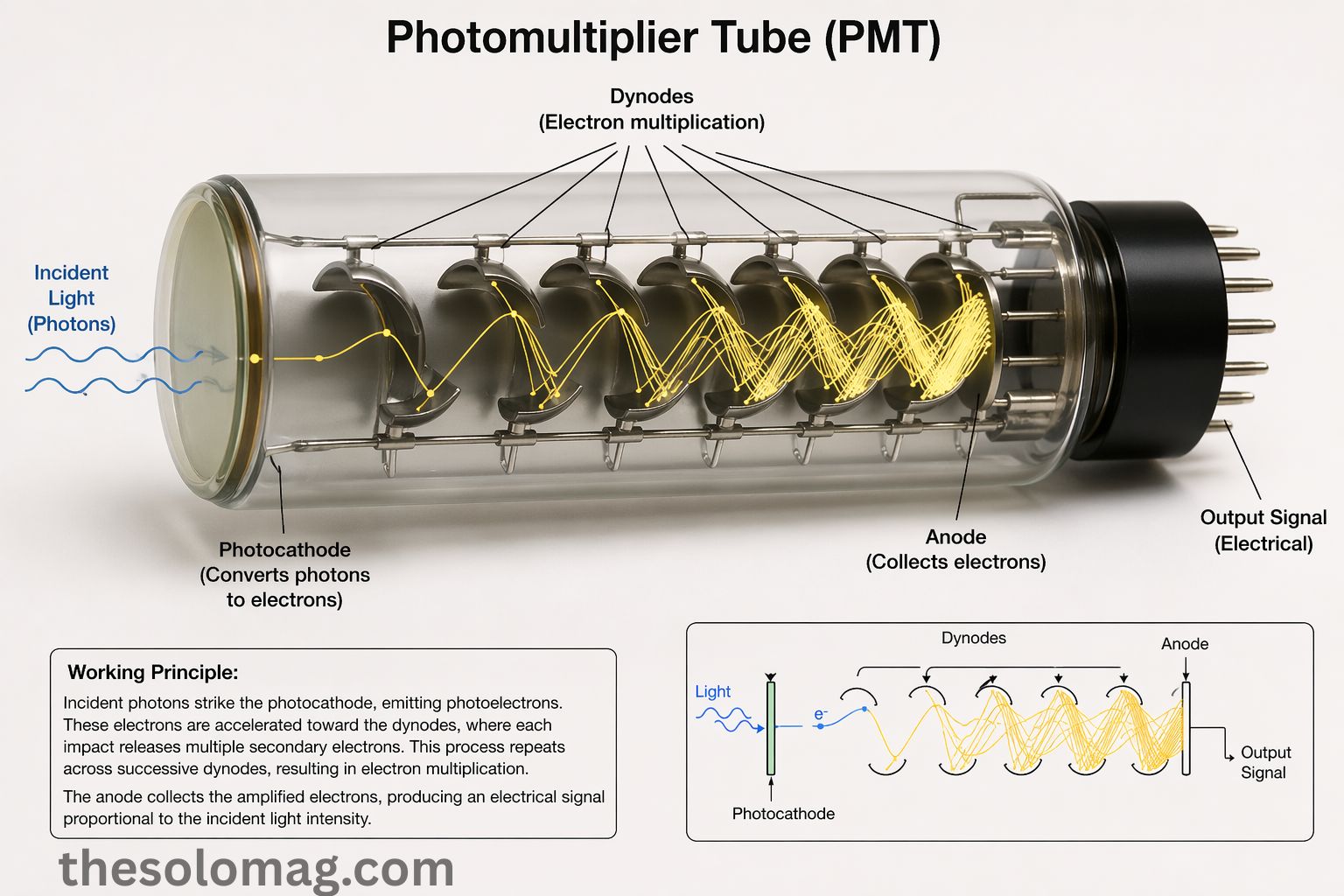
You’ve probably never thought about how a hospital scanner sees cancer cells before they grow. Or how a physicist watches a neutrino pass through a mile of ice. But at the heart of these miracles sits a small, unassuming hero: the photomultiplier tube.
In 2026, as quantum sensing and ultra-low-light detection become mainstream, understanding how a photomultiplier tube works is no longer just for lab coats. It’s for engineers, medical device startups, and even hobbyists building next-gen lidar systems.
Let’s cut through the noise. No robotic definitions. Just real talk about one of the most sensitive light detectors ever made.
So, What Is a Photomultiplier Tube Exactly?
A photomultiplier tube (PMT) is a vacuum tube that converts tiny amounts of light—sometimes just a single photon—into a measurable electrical signal. Think of it as a microphone, but for light. And a very loud one at that.
Where a standard camera sensor might miss a few photons, a pmt photomultiplier tube amplifies that light millions of times. We’re talking about detecting a candle flame from 50 miles away. No joke.
Real-life daily example:
Ever had a blood test for thyroid issues? That chemiluminescence immunoassay likely used a hamamatsu photomultiplier tube to spot hormone molecules by their faint glow. Without PMTs, many early disease diagnoses would be blind.
The Core Components (No PhD Required)
-
Photocathode – Absorbs light and spits out electrons.
-
Dynodes – A staircase of metal plates. Each step multiplies electrons.
-
Anode – Collects the final avalanche of electrons.
How does a photomultiplier tube work?
One photon hits the photocathode → one electron flies off → that electron hits the first dynode and releases 4–6 more electrons → those hit the next dynode, and so on. After 10–14 dynodes, you get 106106 to 108108 electrons from a single photon. That’s gain you can measure with cheap electronics.
Related: How Avalanche Photodiodes Compare to PMTs for LIDAR
How a Photomultiplier Tube Works – The Step-by-Step (2026 Edition)
Let’s walk through how a photomultiplier tube works like you’re debugging one in your lab or garage.
-
Photon arrival – Light enters through a window. Even ultraviolet or near-infrared works, depending on the photocathode material.
-
Photoelectric effect – The photocathode emits a primary electron. This is Einstein’s old magic, now inside a glass envelope.
-
Electron focusing – An electrode steers the electron toward the first dynode.
-
Multiplication cascade – Each dynode is at a higher voltage (typically +50–100V per stage). Electrons slam into each dynode, knocking out secondary electrons.
-
Signal collection – The anode sums the final current. Rise times are often under 2 nanoseconds.
How do photomultiplier tubes work in a real instrument?
Take a flow cytometer (used to count immune cells). Lasers excite fluorescent tags on cells. The faint emitted light—picowatts—hits a PMT. The output pulse tells you exactly how many receptors are on that cell.
Why Not Just Use a Camera Sensor?
Modern CMOS sensors are great for selfies. But they suffer from read noise and dark current. A photomultiplier tube has near-zero read noise and can count single photons. For low-light quantum optics or neutrino detectors, there’s no substitute.
The Most Trusted Name – Hamamatsu Photomultiplier Tube
When engineers say “PMT,” they often mean a hamamatsu photomultiplier tube. Why? Because Hamamatsu has been perfecting vacuum tube technology since 1953. Their R-series PMTs are industry benchmarks.
What makes Hamamatsu different?
-
Super bialkali photocathodes for high quantum efficiency (up to 45% at 400 nm)
-
Low dark count rates (as low as 10–100 counts per second)
-
Ruggedized metal packages for portable instruments
In 2026, you’ll find hamamatsu photomultiplier tube modules in handheld spectrometers, oil drilling sensors, and even space telescopes. They’re the Toyota Hilux of light detectors: reliable, repairable, and everywhere.
Pro tip: If you’re designing a medical diagnostic device, start with Hamamatsu’s application notes. They practically give away the engineering.
How Does a Photomultiplier Tube Work in Real-Life Applications?
Let’s make this concrete. How does a photomultiplier tube work outside a physics lab?
| Application | What the PMT sees | Why PMT wins |
|---|---|---|
| PET scanner | Gamma rays converted to light by a scintillator | Nanosecond timing to locate tumors |
| LIDAR (autonomous cars) | Reflected laser pulses from 200m away | Single-photon sensitivity in fog |
| Environmental monitoring | Bioluminescence in ocean water | Detects one microorganism per liter |
| High-energy physics | Cherenkov light from neutrinos | Covers square meters of detector area |
Daily example:
That COVID-19 PCR test? The “real-time” part often used a photomultiplier tube to detect fluorescent probes as DNA amplified. Without PMTs, results would take hours longer.
What Is Photomultiplier Tube Sensitivity in Numbers?
Let’s talk specs. A typical photomultiplier tube achieves:
-
Gain – 106106 to 108108 (that’s 120–160 dB)
-
Quantum efficiency – 20–45% (photons in → electrons out)
-
Dark current – 1–100 nA (without any light)
-
Rise time – 0.5 to 3 ns (faster than most oscilloscopes)
Compare that to a photodiode: gain of 1, rise time of 10–50 ns. How does a photomultiplier tube work so much faster? Electrons fly in vacuum, not through sluggish silicon.
Pros and Cons of Photomultiplier Tubes (2026 Reality Check)
Nothing is perfect. Here’s the honest trade-off.
Pros
-
Unmatched sensitivity – Count individual photons.
-
Fast response – Sub-nanosecond timing for fluorescence lifetime measurements.
-
Large area – You can buy PMTs with 50 mm diameter photocathodes.
-
Linear response – Over 6 orders of magnitude of light intensity.
-
Robust – No semiconductor damage from static discharge.
Cons
-
Bulky – A PMT is a glass tube, not a chip. Minimum size ~1 cm diameter.
-
High voltage – Needs 500–2000V. Not battery-friendly.
-
Magnetic sensitivity – Earth’s field can bend electron paths. Mu-metal shielding required.
-
Fragile – Glass envelope. Mechanical shock is bad news.
-
Lifetime – Photocathode degrades over years, especially in UV.
Related: When to Choose a Silicon Photomultiplier (SiPM) Over a PMT
Photomultiplier Tube Variations You Should Know
Not all PMTs are the same. Here are the main flavors for 2026 applications:
-
Head-on type – Light enters the end. Best for large area detection (scintillation counting).
-
Side-on type – Light enters the side. Cheaper, used in spectrophotometers.
-
Microchannel plate PMT (MCP-PMT) – Uses tiny glass channels instead of dynodes. Picosecond timing for particle physics.
-
Position-sensitive PMT – Multiple anodes to detect where the photon hit. Great for imaging.
What is photomultiplier tube choice for a startup?
If you’re building a low-cost water quality sensor, a side-on PMT from Excelitas or Hamamatsu will run $200–500. For a time-of-flight mass spectrometer, you need a fast MCP-PMT ($1500+).
How Are Photomultiplier Tubes Used in 2026’s Hottest Fields?
Let’s peek into the future.
Quantum computing – Researchers use photomultiplier tubes to detect heralded single photons from quantum dots. Low noise is critical.
Underwater neutrino telescopes – KM3NeT in the Mediterranean strings hundreds of PMTs on cables to catch neutrinos from supernovae.
Space debris lidar – NASA’s latest orbital debris sensor uses a pmt photomultiplier tube to spot 1 cm fragments at 1000 km range.
Point-of-care diagnostics – Portable PMT modules now run on 12V DC and fit in a shoebox. Rural clinics use them for HIV viral load tests.
FAQs
Q:1 What is a photomultiplier tube used for?
Detecting extremely weak light – from medical imaging (PET, blood tests) to physics research (neutrino detectors, quantum optics) and industrial lidar.
Q:2 How does a photomultiplier tube work in simple terms?
It turns one photon of light into a shower of millions of electrons, like a snowball rolling downhill and growing larger.
Q:3 Is a photomultiplier tube still relevant in 2026?
Yes. While silicon photomultipliers (SiPMs) are gaining ground, PMTs still offer larger area, lower dark count, and better radiation hardness.
Q:4 What’s the difference between a PMT and a photodiode?
A PMT has internal gain (millions); a photodiode has gain of 1. PMTs are for photon counting; photodiodes for brighter light.
Q:5 Why is Hamamatsu so popular for PMTs?
They offer decades of reliability, extensive application support, and the widest range of photocathodes and packages.
Q:6 How much does a photomultiplier tube cost?
$100–$500 for general-purpose side-on types; $1000–$5000 for fast, large-area or MCP-PMTs.
Q:7 Can a photomultiplier tube be damaged by bright light?
Yes. Prolonged exposure to room light can reduce gain or increase dark current. Always keep PMTs in darkness when powered.
Q:8 What voltage does a PMT need?
Typically 500 to 2000 volts DC, delivered through a resistive voltage divider.
Q:9 How do photomultiplier tubes work for single photon counting?
They produce discrete pulses for each photon. A discriminator counts pulses above a threshold, ignoring electronic noise.
Q:10 What is the lifetime of a photomultiplier tube?
5–10 years in normal use. Photocathode degradation is the main limit, especially with UV exposure.
Q:11 Are photomultiplier tubes affected by magnetic fields?
Yes. Even the Earth’s field (0.5 Gauss) can change gain. Use mu-metal magnetic shielding for precision work.
Q:12 How does a photomultiplier tube work compared to an avalanche photodiode (APD)?
PMTs have lower excess noise factor (F~1.2) vs APDs (F~2–5) at high gain, making PMTs better for very low light.
Q:13 Can I build a PMT-based detector at home?
Yes, with caution. Used PMTs are cheap on eBay. You’ll need a high-voltage supply (start with a 12V to 900V DC-DC converter) and a transimpedance amplifier. Be safe – high voltage kills.
Conclusion
The photomultiplier tube is over 80 years old. It’s bulky. It needs high voltage. And yet, in 2026, it remains the gold standard for detecting the faintest whispers of light.
Whether you’re a medical device engineer, a physics student, or just someone curious about how a photomultiplier tube works, remember this: every time a doctor catches a tumor early, or a scientist confirms a new particle, there’s a good chance a PMT saw it first.
They’re not glamorous. They’re not “AI-powered.” But they work. Reliably. Quickly. And with a sensitivity that still makes modern silicon blush.
Next step: Grab Hamamatsu’s “PMT Handbook” (free PDF). Then buy a cheap PMT module on eBay and build a scintillation counter. You’ll never look at light the same way again.
Pros and Cons
| Pros | Cons |
|---|---|
| Single-photon sensitivity | Requires 500–2000V supply |
| Sub-nanosecond timing | Fragile glass envelope |
| Large detection area (up to 50 mm) | Sensitive to magnetic fields |
| Extremely low noise | Bulky (not chip-scale) |
| Linear over 6 decades of intensity | Photocathode degrades over time |
| Radiation-hard (no semiconductor damage) | High cost for fast MCP variants |
| Decades of proven reliability | Needs dark operation (no ambient light) |
FOR FURTHER INFORMATION, VISIT: THESOLOMAG