
 By Admin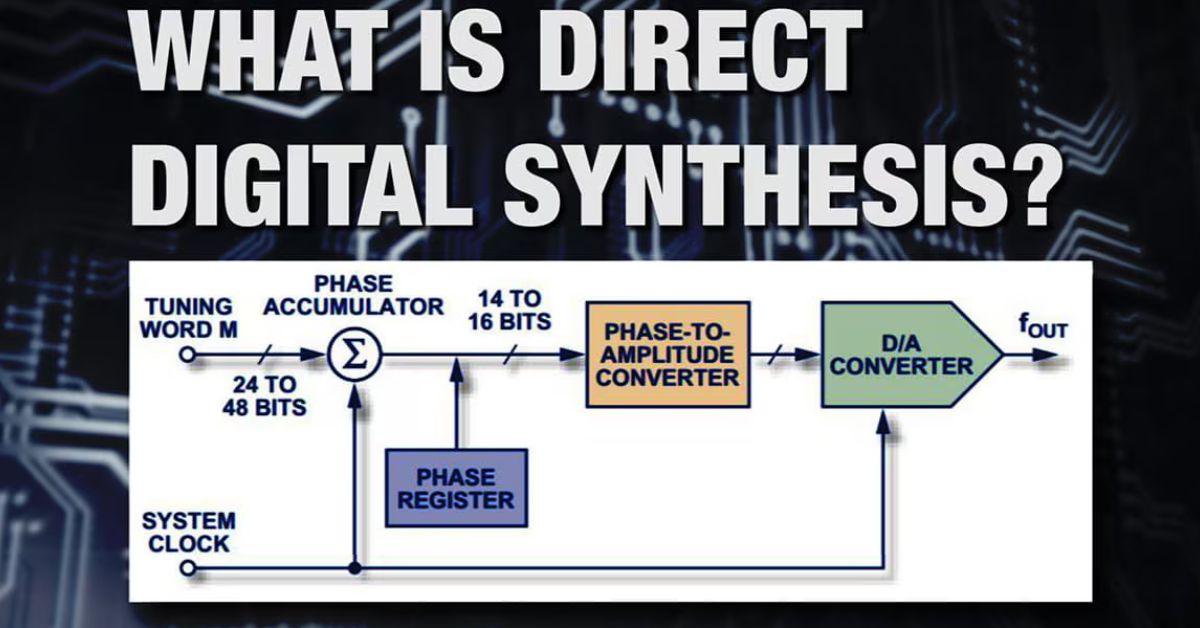
Ever wondered how modern devices generate precise signals so effortlessly—whether it’s your smartphone connecting to a network or a lab instrument producing perfectly shaped waveforms? That’s where Direct Digital Synthesis (DDS) quietly does its magic behind the scenes. It’s one of those technologies you rarely hear about, yet it powers a massive portion of today’s electronic systems.
At its core, DDS is a smart, digital way of creating analog signals using mathematical calculations instead of traditional hardware-heavy methods. Think of it like a digital artist sketching a waveform point by point, then turning that sketch into a real, usable signal. This approach gives engineers incredible control over frequency, phase, and waveform shape—something older analog systems simply can’t match with the same level of precision.
What makes DDS truly exciting is its flexibility. Need to change frequency instantly? It can do it in a blink. Want ultra-fine control for scientific measurements or communication systems? It handles that with ease. From radar systems and wireless communication to test equipment and even audio synthesis, It has become a cornerstone of modern electronics.
In this guide, we’ll break down everything you need to know about DDS in a simple, engaging way—so whether you’re a student, engineer, or just curious about how technology works, you’ll walk away with a clear and confident understanding.
Understanding DDS Basics
What Does DDS Stand For?
It stands for Direct Digital Synthesis, a modern electronic technique used to generate signals—especially waveforms like sine waves—using digital methods. Unlike older analog approaches, It relies heavily on digital processing to create precise and controllable frequencies. If you’ve ever wondered how modern communication systems manage to stay so accurate and flexible, it is one of the hidden heroes behind the scenes.
Think of DDS as a digital musician. Instead of playing instruments physically, it “calculates” each note mathematically and then converts it into sound (or signal). This ability to compute signals digitally gives DDS incredible control and flexibility that traditional systems simply cannot match.
Simple Definition of DDS
At its core, Direct Digital Synthesis is a method of generating analog signals using digital calculations and then converting them into usable waveforms.
Here’s the simple idea:
- A digital system creates waveform data.
- That data is converted into an analog signal.
- The result is a clean, adjustable frequency output.
It is widely used in electronics because it allows extremely fine control over frequency, phase, and waveform shape—all from digital inputs.
How DDS Works
Core Components of DDS
To understand It deeply, you need to know its three main building blocks.
Reference Clock
The reference clock acts as the heartbeat of the system. It provides a stable timing signal that everything else relies on. The accuracy of the DDS output depends heavily on this clock.
Numerically Controlled Oscillator (NCO)
The NCO is the brain. It uses digital values to calculate waveform samples. Instead of generating signals physically, it computes them mathematically using a “frequency tuning word.”
Digital-to-Analog Converter (DAC)
Finally, the DAC converts the digital signal into a real analog waveform that devices can use—like radio signals or test signals.
Step-by-Step Working Process
Let’s break it down in a way that feels natural:
- A reference clock sends steady pulses.
- The NCO uses these pulses to calculate waveform values.
- These values are stored or generated digitally.
- The DAC converts them into an analog signal.
- A filter cleans up the output.
In essence, it builds a waveform point by point—like drawing a picture pixel by pixel—until a smooth signal appears. This method allows extremely precise control over frequency and phase.
Key Features of DDS Technology
Frequency Precision
One of the biggest strengths of DDS is ultra-high frequency resolution. Because it uses digital tuning words, even tiny adjustments can change the output frequency. This makes DDS ideal for applications requiring fine control, such as scientific instruments or wireless communication.
Imagine being able to tune a radio not just to a station, but to a specific fraction of a frequency—It makes that possible.
Phase Control
It doesn’t just control frequency—it also controls phase. This means signals can be shifted precisely in time, which is crucial for systems like radar or modulation.
Phase control allows multiple signals to work together without interfering, almost like perfectly synchronized dancers.
Advantages of DDS
Speed and Flexibility
It can switch frequencies almost instantly. Unlike traditional systems, which may take time to stabilize, It can jump between frequencies without glitches.
This makes it perfect for:
- Frequency hopping systems
- Agile communication systems
- Modern radar technology
Cost Efficiency
Because It relies on digital circuits, it often requires fewer components. This leads to:
- Smaller designs
- Lower power consumption
- Reduced costs
Modern DDS chips are compact and energy-efficient, making them ideal for portable devices.
Limitations of DDS
Noise and Distortion
No technology is perfect. It systems can produce:
- Spurious signals (spurs)
- Quantization noise
- Aliasing effects
These issues arise because it works with discrete digital values rather than continuous signals.
Hardware Constraints
It performance depends on:
- Clock speed
- DAC quality
- Processing power
Higher frequencies require faster hardware, which can increase complexity and cost.
DDS vs Traditional Methods
DDS vs PLL
| Feature | DDS | PLL |
|---|---|---|
| Speed | Very fast switching | Slower |
| Accuracy | Extremely precise | Good |
| Complexity | Lower | Higher |
| Noise | Higher spurs | Lower noise |
It offers better flexibility, while PLL (Phase-Locked Loop) systems often provide cleaner signals.
DDS vs Analog Oscillators
Analog oscillators rely on physical components, while DDS uses digital computation. This makes DDS:
- More stable over time
- Easier to control
- Less sensitive to environmental changes
Applications of DDS
Communication Systems
It plays a huge role in:
- Mobile networks
- Satellite communication
- Wireless devices
It helps generate carrier signals and enables frequency modulation with precision.
Test and Measurement Equipment
In labs, It is used in:
- Function generators
- Signal analyzers
- Calibration tools
Its precision makes it ideal for testing electronic devices.
Real-World Examples
Signal Generators
It is commonly used in signal generators to produce:
- Sine waves
- Square waves
- Triangle waves
These are essential for testing circuits and systems.
Radar Systems
Modern radar systems rely on DDS for:
- Frequency agility
- Accurate signal timing
- Phase synchronization
This ensures accurate detection and tracking.
Future of DDS Technology
The future of DDS looks incredibly promising. With advancements in semiconductor technology, DDS systems are becoming faster, smaller, and more efficient.
We’re likely to see DDS integrated into:
- 5G and 6G networks
- Advanced medical equipment
- AI-driven communication systems
As digital processing continues to evolve, It will become even more powerful and widespread.
Conclusion
DDS, or Direct Digital Synthesis, is a powerful and flexible technology that has revolutionized how signals are generated. By combining digital precision with analog output, it offers unmatched control over frequency and phase.
From communication systems to laboratory equipment, it is everywhere—even if you don’t see it. Its ability to generate accurate, stable, and adjustable signals makes it a cornerstone of modern electronics.
Understanding DDS is like unlocking a secret layer of technology that powers much of the modern world.
FAQs
1. What is DDS in simple words?
It is a digital method used to generate analog signals like sine waves using mathematical calculations.
2. Where is DDS used?
It’s used in communication systems, signal generators, radar systems, and testing equipment.
3. Why is DDS important?
It provides precise frequency control, fast switching, and flexibility, making it essential in modern electronics.
4. What are the disadvantages of DDS?
It can produce noise and requires high-speed hardware for high-frequency applications.
5. Is DDS better than PLL?
It depends on the application—it is more flexible and faster, while PLL offers cleaner signals.
FOR FURTHER INFORMATION,VISIT: THESOLOMAG